What Happens During a Cataract Consultation?
Learn About Cataract Consultations at Marietta Eye Clinic
The cataract evaluation visit is lengthy and can take a couple of hours because of all the information we need to collect in order to make the best decisions in planning for your eye surgery. The cataract evaluation visit starts with a thorough examination and a work-up by one of our trained ophthalmic technicians. We will review all of your medications and your past medical history and then carefully listen to you as you explain your symptoms to understand the impact of your vision on your life. The next step involves diagnostic tests in which we measure different aspects of the eye, including the curve of the surface and the length of your eye. We use the most advanced technology and the best equipment in order to gather the best and most accurate information regarding your eye. This will help us determine what type of lens and the power of that lens to go in your eye to replace your cataract.
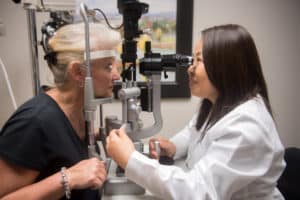
A physician will then meet with you, carefully listen to you and review your symptoms and vision concerns and perform a complete dilated ophthalmic examination to evaluate the entire eye. This is to make sure that you actually have a cataract that is visually significant; in doing so, your doctor will also rule out any other ophthalmic diseases that you may have that also can be impacting your vision. After completing the ophthalmic examination and discussing together your surgical options, you will see a surgery coordinator who will then talk to you about the appointment date of the surgery, review your insurance benefits, and also coordinate any possible consultations you may need with your cardiologist, pulmonologist, or another primary care doctor prior to your surgery.
More on What to Expect at Your Cataract Surgery Consultation
Are you ready for cataract surgery? To begin this process, you’ll need to participate in a cataract consultation. This consultation takes about an hour and a half to two hours. This is because it includes a complete examination and test before cataract surgery. We’ll also answer all of your questions and explain the procedure. Let’s take a look at what’s involved in the evaluation for cataract surgery.
How to Prepare for Your Cataract Consultation
Your cataract evaluation is a consultation and an exam. The consultation is to learn about your medical history and the issues the cataracts are causing in your daily life. The exam involves a visual acuity test, a dilated eye exam, a slit lamp exam, a retinal exam and a tonometry test, which checks your eye pressure.
Things to Bring with You
- Your medical history
- A list of any eye conditions in your family
- A list of any pre-existing conditions that you have
- A list of the medications that you are taking, including OTC and prescription medications
- Your insurance card
- Any new patient paperwork that you filled out before the appointment
- A family member or friend to drive you home from the appointment
Steps to A Successful Cataract Consultation
You should expect to spend about two hours at our eye doctor’s office for your cataract assessment appointment.
1. Medical History
The first step in your cataract consultation is taking a complete medical history. This includes any OTC and prescription medications that you are currently taking, any health issues or conditions you may have and any eye diseases or conditions in your immediate and extended family that you know about. We need this information in order to determine if you’re a good candidate and if any special precautions need to be taken before, during or after your cataract surgery. For example, if you have diabetes or are taking a blood-thinning medication, the backs of your eyes may be more prone to bleeding during or after the surgery.
2. Vision Test
The vision test is much like you’d have performed for any vision exam. This involves reading lines of letters and numbers on a chart and getting a slit lamp exam, which checked your iris, lens and cornea. We’ll also examine your current glasses prescription.
3. Eye Examination
The eye exam part of the test involves checking your overall eye health. During this portion, your eyes will be dilated by our ophthalmologist. For this reason, we recommend bringing someone with you who can drive you home. This part of the exam checks the back of your eye and looks for any health condition that may hinder the cataract surgery.
4. Eye Measurements
During your consultation, measurements will be taken of your eye in order to help determine which intraocular lens (IOL) would be best for you. The measurements of your eye will include the corneal curvature, the axial length and the anterior chamber depth.
5. Explanation of Cataract Surgery
Once the exam is complete our eye doctor will explain the cataract surgery and what you can expect before, during and after the surgery.
6. Answering Your Questions
Our ophthalmologist will answer any questions you have about the cataract surgery and clarify anything that may be confusing to you. If you have questions before your eye surgery, you can always call our ophthalmologist or optometrist.
7. Preoperative Instructions
If you’re determined to be a good candidate, our eye doctor will hand you a list of preoperative instructions. For example, you’ll need to bring someone with you or arrange a ride to and from your surgery appointment because you won’t be able to see well enough after the surgery to drive yourself. You’l be given eye drops that you’ll have to start putting in the eye that will be receiving the surgery up to three days prior. On the day of your surgery, it’s important not to wear any makeup, lotions or perfumes as these could inadvertently get into your eyes and cause an infection. It’s important to read the list of preoperative instructions and ask any questions you may have about them.
Common Questions About Cataract Surgery
How long does a cataract surgery evaluation take?
You can expect your cataract surgery evaluation to take between 1.5 and 2 hours. This amount of time is needed in order to get your complete medical history, perform all the eye exams, explain the surgery to you and answer your questions.
How long does it take to measure eyes for cataract surgery?
It doesn’t take very long to perform the measurement portion of the eye examination. It’s part of the cataract surgery evaluation and is included in your total time for the appointment.
How long after consultation is cataract surgery?
Cataract surgeries are usually scheduled between 2 and 4 weeks after the cataract testing and consultation. this will be dependent on your schedule and the schedule of the cataract surgeon. If you need cataract surgery in both eyes, the first eye will be done on one day, and the second eye will receive cataract surgery a few weeks later.
How long does the cataract surgery take?
Cataract surgery is performed under local anesthesia. The surgery takes about 20 minutes.
What prevents me from moving or moving my eyes during cataract surgery?
Just before the surgery, you’ll be given a light sedative, and your eye will be numbed. Additionally, a device will be placed in your eye that helps prevent movement of the eye and eyelid. If a laser is used to perform the surgery, it contains tracking software and automatically stops if movement of the eye is detected.
Are there any risks with having cataract surgery?
Cataract surgery has a success rate of 97 percent, meaning that 97 percent of people who undergo cataract surgery experience improved vision. The biggest risk of cataract surgery is infection, so it’s important to watch for signs of an eye infection and not to rub your eye after the surgery. Additional complications can include retinal detachment, swelling, bleeding and glaucoma. Some people may even experience a drooping eyelid. Our eye doctor can answer all of your questions in regard to possible complications.
Schedule a Cataract Surgery Consultation with Marietta Eye Clinic
Simply make an appointment online or contact us to set up an initial consultation and exam by calling 678-784-0235.
Set Up A Consultation
When it comes to your eyes, nothing beats a face-to-face consultation with one of our eye doctors. Request an appointment to meet with one of our specialists.
More About Cataract Surgery
7/31/2018
What Should I Know About Premium Lens Options?
7/31/2018
Learn if You are Ready for Cataract Surgery
7/31/2018