What Should I Know About Premium Lens Options?
Premium intraocular lenses can help restore the vision of your youth. You can see significantly better after cataract surgery with premium lenses. In the past, cataract patients only had one choice for replacement lenses during cataract surgery: monofocal lenses. These are still offered today. They provide vision at one distance only, typically long distances, and reading glasses are usually required for up-close activities. Today, patients have the opportunity to see better after cataract surgery with multifocal or accommodating Intraocular Lens (IOL) implants. These lens implant options enable vision at multiple distances, often reducing or eliminating the need for glasses.
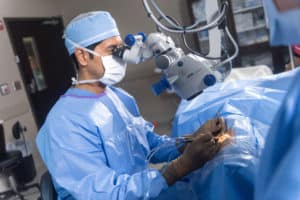
Premium Lens Options in Atlanta
Multifocal IOL Implants: AcrySof® ReSTOR® IOL or TECNIS® IOL
Accommodating IOL Implants: Crystalens®
Toric IOL Implants for Astigmatism: AMO TECNIS® Toric IOL or AcrySof® IQ Toric IOL
Multifocal IOLS
These lenses provide enhanced image quality and a full range of vision — near, far and everywhere in-between — for increased independence from reading glasses or bifocals. We are proud to offer two types of multifocal lenses: ReSTOR and TECNIS. Both of these options can provide crisp, clear vision for patients after surgery.
Accommodating IOLs
The process of an eye focusing from distance to near is known as accommodation. Accommodating lens implants restore an increased range of vision. These lenses mimic the way an eye’s natural lens would see by accommodating to change the lens focus from distance to near range, much like youthful eyes.
Crystalens Accommodating IOL
The only accommodating lens available is the Crystalens by Bausch & Lomb. The Crystalens acts like the eye’s natural lens, using the eye muscles to flex and accommodate in order to focus on objects at a broad range of distances. The Crystalens dynamically adjusts to your visual needs while maintaining superior quality vision. It not only treats your cataracts but addresses your full range of vision. Many Crystalens patients rarely need glasses or contact lenses.
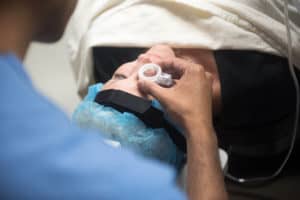
Crystalens Clinical Trials
98.4% of patients implanted with Crystalens in both eyes could pass a driver’s test without glasses.
100% could see intermediate (arm’s length) vision without glasses, the distance for most of life’s activities.
98.4% could see well enough to read the newspaper and the phone book without glasses.
74% of patients never or almost never wore eyeglasses.
Significantly more patients implanted with a Crystalens (88.4%) could see better at all distances than patients implanted with a standard IOL (35.9%). Long term results with the Crystalens means a safe and effective procedure and more than 150,000 have been implanted.
Toric IOLs
Cataract patients with astigmatism can have both conditions corrected during cataract surgery by having the AMO TECNIS® Toric IOL or AcrySof® IQ Toric IOL implanted. The unique design of this lens makes it possible to reduce or eliminate astigmatism resulting in the patient being practically lens-free after cataract surgery (except for the need for reading glasses).
Other methods to correct astigmatism during cataract surgery
The most common cause of astigmatism is asymmetry of the cornea, the clear dome over the colored part of the eye. The cornea should be spherical in shape, like a basketball cut in half. An astigmatic cornea is shaped more like a football cut in half. In lower levels of astigmatism, a Toric IOL may not be necessary. In these situations, your surgeon can perform an Astigmatic Keratotomy at the conclusion of your cataract surgery. This procedure involves using a special diamond blade scalpel to make two microscopic incisions in the periphery of the cornea thus eliminating your astigmatism.
Set Up A Consultation
When it comes to your eyes, nothing beats a face-to-face consultation with one of our eye doctors. Request an appointment to meet with one of our specialists.
More about Cataract Surgery
8/1/2018
Learn if You are Ready for Cataract Surgery
8/1/2018
What Happens During a Cataract Consultation?
8/1/2018