Types of Cataract Lenses to Choose From
August 28, 2024
Do you need cataract surgery but aren’t sure what type of intraocular cataract lenses would best benefit you? Cataracts occur when the lens of the eye becomes clouded by proteins. This usually starts to happen after a person reaches the age of 40, and it can cause your vision to become blurry. Colors can also appear dull or faded. Some individuals have even reported that they see a yellow hue.
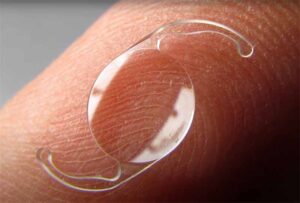
While glasses and contacts can improve vision for a short time, eventually, the cataracts must be removed via surgery. During cataract surgery, the eye surgeon removes the natural lens and replaces it with an artificial lens for cataracts, which are called intraocular lenses. The lens replacement surgery takes a relatively short amount of time, usually no more than 20 minutes. At Marietta Eye Clinic, we perform cataract surgeries at our surgery center. Let’s look at the various types of artificial lenses for cataracts, what they do and their benefits and drawbacks.
Why Are Intraocular Lenses Needed After Cataract Surgery?
Cataracts occur when the natural lens in your eye becomes cloudy due to the breakdown of proteins in the natural lens. Those proteins clump together, creating a cloudy or white spot on the lens of your eye that negatively impacts your visual acuity. In the beginning, your eye doctor may be able to prescribe glasses or contacts to help you see better, but eventually, you’ll need cataract surgery.
If you’re having trouble driving at night and seeing clearly, it’s probably time to look into cataract surgery and IOL implantation. Intraocular lenses at Marietta Eye Clinic can be purchased as monofocal lenses, multifocal cataract lenses, extended depth of focus lenses and toric cataract lenses, and they’re generally manufactured out of acrylic, silicone or another type of plastic composite to ensure they’re durable and safe. The type of lens you choose will be dependent on your needs, lifestyle and budget.
Monofocal Intraocular Lenses (IOLs)
Monofocal cataract lenses contain one prescription for vision correction. You can think of these cataract lenses like a basic glasses prescription where the lenses have one prescription across the entire surface. When it comes to monofocal IOLs, most people choose distance vision so that they can drive, go for a walk and see far away. Then, they wear reading glasses in order to read the newspaper, a book or other item.
Monofocal Pros
Monofocal lenses are cost-effective and are usually covered under most insurance plans. Individuals who get these lenses can expect high-quality distance vision so that they can drive, watch TV and participate in recreational activities, like hiking, walking and playing sports.
Monofocal Cons
Monofocal lenses don’t eliminate the need for glasses. Many individuals still need reading glasses after having monofocal lenses inserted into their eyes.
Multifocal Intraocular Lenses (IOLs)
Multifocal intraocular lenses (IOLs) have more than one vision prescription. These are similar to bifocal or trifocal glasses, where the lenses contain prescriptions for near, intermediate and distance vision. As the individual wears the lenses, the brain develops the ability to automatically switch between those various distances. Multifocal IOLs work well for people who want to reduce or eliminate their need for glasses after cataract surgery.
Multifocal Intraocular Lens Pros
Multifocal IOLs can help people see clearly at a range of distances. This helps eliminate the need for glasses after cataract surgery.
Multifocal Intraocular Lens Cons
Multifocal lenses are more expensive than monofocal lenses. Additionally, some people’s brains may have difficulty adapting to the near, intermediate and distance vision prescriptions in the lenses. Some people have even reported glare and halos at night after getting multifocal IOLs.
Extended Depth of Focus (EDOF) Intraocular Lenses
Extended depth of focus (EDOF) intraocular lenses are technologically advanced lenses that can help individuals see clearer through a range of distances. With traditional mutlifocal lenses, individuals may have issues with blurry spots or gaps as they switch between near, intermediate and distance vision. When you choose an EDOF lens, the transitions between distances are smoother, resulting in fewer gaps.
Certain types of extended depth of focus lenses are designed to correct presbyopia. They boast high-contrast vision and fewer visual gaps than traditional multifocal IOLs.
Extended Depth of Focus Pros
EDOF lenses offer great contrast and clearer vision across distances. At Marietta Eye Clinic, we offer IOLs known for reducing glare and halos, due to their violet-filtering technology. The Journal of Ophthalmology published a study on EDOF lenses that encompassed several different types by several different manufacturers and found that 90 percent of EDOF recipients were completely or moderately satisfied with their visual acuity after cataract surgery and the installation of the EDOF lenses.
Extended Depth of Focus Cons
EDOFs are more costly than monofocal and multifocal lenses. While EDOFs provide excellent intermediate and distance vision, the near vision may not be close enough for some individuals. The lenses are often able to help people focus on objects and text as close as 12 inches, but individuals may need reading glasses if they need to view objects and read at distances closer than 12 inches.
Toric Intraocular Lenses (IOLs)
Toric intraocular lenses (IOLs) come in two styles, monofocal and multifocal. Toric IOLs, just like toric contact lenses, provide correction for astigmatism, which is a condition that causes the cornea or lens of the eye to be misshapen. When an individual with an astigmatism needs cataract surgery, toric IOLs are often recommended in order to provide the individual with the best possible outcome. Choosing between a monofocal and a multifocal toric lens depends on the individual, the degree of the astigmatism and their overall eye health.
Toric Intraocular Lenses (IOLs) Pros
Toric IOLs are excellent at correcting astigmatism in people who need cataract surgery. Individuals who get toric IOLs instead of non-toric IOLs have a reduced need for glasses.
Toric Intraocular Lenses (IOLs) Cons
Toric IOLs can be more difficult to place because the lens must be placed very precisely. This is because toric lenses are designed to correct a misshapen cornea so that light is reflected correctly on the back of the eye.
Factors to Consider When Choosing a Lens
More than 20 million people in the United States, who are over the age of 40, have cataracts. The only way to remove cataracts is by removing the natural lens and replacing it with an artificial lens during cataract surgery, which means you might be wondering what type of intraocular lens would best benefit you.
The truth is that it depends on your vision needs, personality, lifestyle, daily activities and budget. If you’re looking for the most affordable option and a lens that may be covered by your medical insurance, you might consider a monofocal lens for distance vision. If you spend a lot of time driving or looking at objects that are far away, a single-vision IOL for distance might also be the right choice.
If your job or hobbies regularly require you to focus on near objects and then far objects, you might choose a multifocal lens. However, deciding to get a multifocal lens also depends on your personality. How well do you think you’d be able to tolerate halos, glare or a shifting visual focus? How long would you be willing to wait for your brain to adapt to the technology in EDOF lenses? Before you choose an IOL, you need to think about your daily life and what you want to accomplish with your new intraocular lenses.
If you’re having trouble deciding which lens would be right for you, our eye surgeon can help you decide by answering your questions and explaining pros, cons and what to expect with each type of lens. This can help you make an informed decision so that you can choose the best IOL for your needs, budget and lifestyle.
The Process of Lens Selection at Marietta Eye Clinic
Our cataract surgeon can help you understand the process of cataract removal and lens selection at your consultation and evaluation. The cataract evaluation and consultation is where our eye surgeon examines your eyes and answers your questions while explaining the cataract surgery to you.
Consultation and Evaluation
Cataract surgery starts with an evaluation and consultation. This appointment can last as long as three hours. This is because we need information about your medical history, and we need to take measurements of your eyes. Next, you’ll undergo a dilated eye exam. This allows our eye doctor to look at the back of your eyes in order to determine your eye health and which types of lenses would work best in your eyes.
Once all of the tests and measurements are completed, our eye doctor will let you know if you’re a good candidate for cataract surgery and answer any questions you have. Our eye surgeon will also ask you about your lifestyle and goals for surgery. All of this information helps ensure that the right IOL is inserted into your eyes.
Laser Cataract Surgery
During your evaluation and consultation, our eye surgeon will also discuss your surgery options. Along with standard cataract surgery, we offer laser-assisted cataract surgery with the CATALYS Precision Laser System. The laser-assisted cataract surgery allows for much smaller incisions and better control over the accuracy of those incisions. Many individuals, who undergo laser cataract surgery, notice better vision 24 hours after the surgery.
Conclusion
Are you having trouble driving at night and experiencing blurry vision during the day? If you’ve noticed a change in your vision and you’re over 65, it could be due to cataracts. Thankfully, cataract surgery can help restore your vision when you choose the right intraocular lens. If you want the most affordable lens, you might consider a monofocal lens. If you want a one-prescription lens that gives you quality distance vision when driving, you might choose a monofocal lens, and if you want to reduce your reliance on glasses after your lens replacement, you might get a multifocol lens.
Are you ready? Schedule your cataract consultation online or call us at 770-427-8111.