Synergy IOL Using State-Of-The-Art Technology
August 31, 2021

What are Cataracts and Presbyopia?
Cataracts are the leading cause of preventable blindness worldwide. By the age of 65, many people will develop cataracts that start to affect their vision. People who have cataracts experience presbyopia, a progressive eye condition, which makes it difficult to focus on close objects and usually becomes noticeable around 45 years of age.
Marietta Eye Clinic is committed to safe and effective treatment using state-of-the-art technology by providing clear vision through modern surgical applications, techniques, and advanced lens options. Our newest lens option, Synergy Intraocular Lens, is the most up-to-date multifocal IOL available, and we are pleased to offer it to our patients.
What is Cataract Surgery and IOLs?
Before discussing Synergy Intraocular Lenses and their benefits, let’s first define cataract surgery and multifocal IOLs. An intraocular lens, commonly referred to as an IOL, is an artificial lens implanted during cataract surgery. IOLs can restore a patient’s vision to the state it was before the development of cataracts — or even better. They are made of silicone, acrylic, or other plastic compositions. Because of the material, IOLs are well tolerated and can protect your eyes from ultraviolet (UV) rays.
Multifocal IOLs allow you to see at multiple distances with one lens. They have multiple focal zones, just like bifocal or trifocal eyeglasses. If you choose to have multifocal IOLs implanted, your brain will naturally recognize a full range of vision. This adaptation is often very quick. Multifocal IOLs generally allow better and more functional vision for activities requiring both distance and near focus. Most people who choose multifocal IOLs become less dependent on glasses after surgery and only require them for a few specific activities. Most patients with multifocal IOLs never pick up glasses again.
One drawback to multifocal IOLs is that they can cause glare or halo from lights and could reduce contrast in your vision, making it harder to see at night or in dim light, so these lenses are not always ideal for patients who intend to do a lot of night driving.
What are the Benefits of Synergy IOLs?
- Provides a large range of vision, both far and near.
- Eliminates the visual gaps present in trifocal and other multifocal technology, giving patients the benefit of a continuous and non-disrupted focus
- Delivers improved performance in low-light conditions
- Diminishes halo intensity for tasks like night driving through violet-filtering technology
- Can correct the astigmatism part of one’s prescription, thereby creating an even sharper image.
How Does Synergy IOLs Compare to other IOLs
Other lenses such as monofocal IOLs, typically only correct one focal point and require you to wear glasses. Other multifocal lens types can provide distance and near vision but may have a fragmented range of vision. Some multifocal lenses that we refer to as Extended Depth of Focus (EDoF) lenses, provide a continuous range of vision but the near vision may not be as functionally clear without glasses.
Are Synergy IOLs Right for Me?
The optimal patient for this type of lens is one who desires to get rid of glasses altogether, but also has otherwise healthy eyes. Conditions such as irregular ocular surface, advanced glaucoma, or macular degeneration may prevent the visual function and limit one’s ability to take advantage of this lens. Your surgeon will evaluate for these types of conditions at the preop visit.
“As a board-certified ophthalmologist, who specializes in cataracts, I am thrilled to be able to offer the newest technology such as Synergy IOL lenses to our patients,” Dr. Wilkin stated. “Cataract surgery is a unique opportunity to address more than just the cloudy lens. This new Synergy IOL corrects distance vision, near vision, and astigmatism all in one lens.”
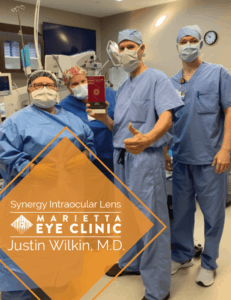
More About Cataract Specialist Justin Wilkin, M.D.
Dr. Wilkin is an ophthalmologist with the Marietta Eye Clinic. He specializes in cataracts and dry eye, in addition to offering comprehensive care. He serves the Kennestone, Canton, and Towne Lake offices. Dr. Wilkin graduated magna cum laude from the Georgia Institute of Technology with his undergraduate degree in applied biology and microbiology. He received his medical degree from the Medical College of Georgia. He is a member of both the American Academy of Ophthalmology and the American Society of Cataract and Refractive Surgeons. He is board-certified by the American Board of Ophthalmology. Read his full bio here.
References and Additional Resources
The American Academy of Ophthalmology (AAO) is the world’s largest association of eye physicians and surgeons. It describes itself as a “global community of 32,000 medical doctors who protect sight and empower lives by setting the standards for ophthalmic education and advocating for our patients and the public.” Its website is a great resource to learn more about how to care for your eyes.
The American Optometric Association (AOA) describes itself as the leading authority on quality care and an advocate for our nation’s health, representing more than 44,000 doctors of optometry (O.D.), optometric professionals, and optometry students.
Johnson & Johnson Vision Introduces TECNIS Synergy™ IOL, a Continuous-Range-of-Vision Intraocular Lens (IOL) at the ESCRS 2019 Congress
https://www.jjvision.com/press-release/johnson-johnson-vision-introduces-tecnis-synergytm-iol-continuous-range-vision
Presbyopia-correcting IOLs
https://eyewiki.org/Presbyopia-correcting_IOLs
Multifocal vs Extended Depth of Focus IOLs
https://www.aao.org/interview/multifocal-vs-extended-depth-of-focus-iols
Set Up A Consultation
When it comes to your eyes, nothing beats a face-to-face consultation with one of our eye doctors. Request an appointment to meet with one of our specialists.