Your Cornea and LASIK by Puneet Panda, M.D.
November 2, 2021
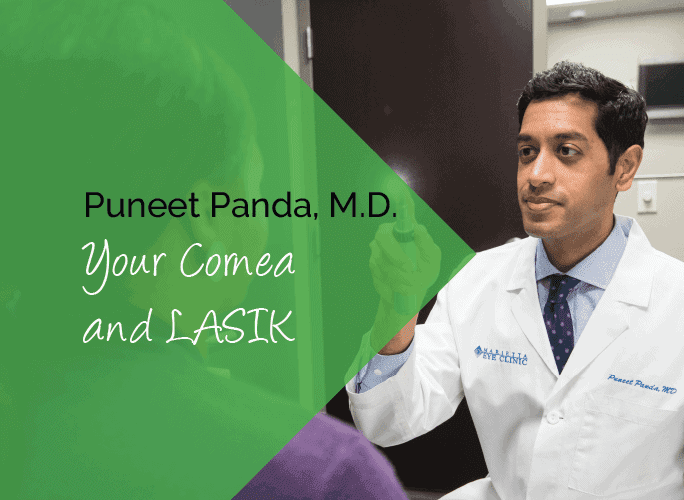
LASIK (Laser In-Situ Keratomileusis) is a type of refractive surgery that reshapes the cornea to enhance vision and eliminate the need for glasses or contact lenses. The procedure involves making a flap in the cornea (the clear dome-shaped covering of the eye) and then reshaping the remaining cornea with a laser to better focus light at the back of the eye.
LASIK can help if you have a treatable refractive error such as nearsightedness, farsightedness, and astigmatism. One can experience dramatically improved vision within 1-2 days after the procedure; most patients can resume normal activities within that time as well. While LASIK is a popular option to help vision correction, reduce dependence on glasses, and contact lenses, it is important to have a thorough evaluation to see if you are an ideal candidate for this procedure.
How LASIK Affects Your Cornea
At Marietta Eye Clinic, we perform bladeless LASIK surgery – providing the most advanced technology and precision. A laser is used to create a thin flap in the cornea. The flap is then lifted, and the cornea is reshaped with a second laser to focus light on the back of the eye to improve vision. Although seemingly simple, it is important to have a comprehensive evaluation as certain preexisting conditions can affect the integrity of the cornea and ocular surface. Some common conditions that make LASIK not optimal in patients are keratoconus and dry eye.
Keratoconus
Keratoconus is a degenerative eye disease that causes progressive weakening and bulging of the cornea. While a healthy cornea is uniformly round, one affected by keratoconus protrudes outward like a cone. Hence, the cornea is inherently weak and performing LASIK on such a cornea can result in further weakening of the cornea, resulting in progressively poor vision and need further surgery to correct this error. To avoid such complications, a comprehensive evaluation of the cornea is performed, including a map of the cornea called topography. Corneal topography is a computerized method of determining the shape and power of the cornea. Measurements are computed and placed into color maps which show steeper and flatter areas. By studying the shape and comparing the parameters to an international database, we can predict how stable the cornea can be after LASIK which helps in guiding the decision to pursue LASIK. Also important is pachymetry, which is how corneal thickness is measured. Ensuring a preoperative thick cornea is vitally important to predict the stability and longevity of LASIK treatment since the cornea is reshaped during the procedure.
Dry Eye
Dry eyes are a common condition in the world today and are becoming increasingly prevalent with increased screen use in all patients. Having significant dry eyes can affect the decision to pursue LASIK. During flap creation, superficial cornea nerves are cut which can reduce ocular surface sensation and therefore influence tear response times. Although many patients recover well and do not have chronic dry eyes after LASIK, patients with preexisting dry eyes can be affected by this. With our comprehensive preop evaluation, our surgeons assess the ocular surface to determine if dry eye would affect your LASIK outcome. For some patients, a health history of inflammatory and autoimmune conditions, including diabetes and inflammatory arthritis, can contribute to dry eye, in which case LASIK may not be the best option for refractive vision correction as flap creation in this station can affect healing. In addition, specific tests to assess tear film osmolarity, inflammation markers, and dye staining on the ocular surface can help to determine the effect of dryness on the eyes.
LASIK alternatives
If a patient is not an ideal LASIK candidate, there are other methods to achieve refractive correction. These include PRK and refractive lens exchange. These options can also be discussed during your LASIK consultation.
In Conclusion
At Marietta Eye Clinic, we pride ourselves on taking a compassionate and conservative approach to refractive surgery. LASIK is a safe and successful procedure; it is becoming one of the most widely studied elective procedures in the world with positive patient satisfaction. While LASIK cannot guarantee perfect vision, there will be a significant improvement to sight and reduce your dependence on glasses. A good LASIK candidate has an exceptionally minimal risk of having complications and proper screening with an experienced surgeon.
If you or a loved one is wondering if LASIK is the best avenue to achieve your best vision, do not hesitate to schedule a free LASIK evaluation with one of our refractive surgeons.
More About LASIK Surgeon Puneet Panda, M.D.
Dr. Panda is an ophthalmologist at the Marietta Eye Clinic who specializes in dry eye, cataracts, LASIK, and cornea, in addition to offering comprehensive ophthalmic care. Dr. Panda graduated from Cornell University with an undergraduate degree in biological and environmental engineering. He received his medical degree from the Jacobs School of Medicine and Biomedical Sciences at the State University of New York at Buffalo and completed his residency at Mount Sinai Hospital in New York. He completed his fellowship in Cornea and Refractive Surgery from the Wilmer Eye Institute of Johns Hopkins University. He is a member of both the American Academy of Ophthalmology and the American Society of Cataract and Refractive Surgeons. Read more about Dr. Panda here.
References and Additional Resources
The American Academy of Ophthalmology (AAO) is the world’s largest association of eye physicians and surgeons. It describes itself as a “global community of 32,000 medical doctors who protect sight and empower lives by setting the standards for ophthalmic education and advocating for our patients and the public.” Its website is a great resource to learn more about how to care for your eyes.
The American Optometric Association (AOA) describes itself as the leading authority on quality care and an advocate for our nation’s health, representing more than 44,000 Doctors of Optometry, optometric professionals, and optometry students.
https://www.allaboutvision.com/conditions/keratoconus-faq/keratoconus-and-lasik.htm
https://www.mayoclinic.org/tests-procedures/lasik-eye-surgery/about/pac-20384774
https://americanrefractivesurgerycouncil.org/everything-you-think-you-know-about-lasik-eye-surgery/
https://www.webmd.com/connect-to-care/lasik/how-does-lasik-eye-surgery-work
https://www.aao.org/eye-health/treatments/lasik
Set Up A Consultation
When it comes to your eyes, nothing beats a face-to-face consultation with one of our eye doctors. Request an appointment to meet with one of our specialists.