What is Amblyopia (Lazy Eye) and How to Treat It
March 28, 2022
What is Amblyopia?
Amblyopia, or lazy eye, is the leading cause of vision impairment in children. It occurs when the brain fails to properly process signals from one eye. Over time, the brain learns to rely heavily on the stronger eye, which in turn worsens the condition of the weaker eye. Early routine eye exams can detect abnormal vision development. It is recommended for all children between the ages of 3 and 5 to get at least one thorough vision screening. If treated early, a child with amblyopia can develop healthy vision.
What Causes Amblyopia?
Amblyopia develops when one eye receives fewer visual signals than the other. This compromises the ability of both eyes to work together efficiently.
In order to present effective treatment options, your child’s ophthalmologist will first identify existing vision problems that have led to amblyopia, which occurs when the ability of both eyes to focus has been compromised. The underlying conditions will be treated first to prevent the brain from relying on the stronger eye, which can lead to amblyopia. Some common eye conditions that cause lazy eye in your child include:
- Strabismus: This term means “eye misalignment”. Strabismus occurs when the eyes are not aligned and there is a muscle imbalance. When the eyes are misaligned, the brain ignores the misaligned eye.
- Refractive errors: The normal process of how light passes through the eye is impacted, resulting in nearsightedness, farsightedness, or astigmatism.
- Cataract: The clouding of the lens can lead to blurred vision and hinder eye development. According to the American Academy of Ophthalmology (AAO), although cataracts are rare in children, they cause more visual disability than any other form of treatable blindness
Signs and Symptoms of Amblyopia
Amblyopia may easily go undetected until your child’s routine eye exam. Symptoms vary by child and in some cases, they may not be displayed at all. There are cases in which children do not complain about their eyesight because their brain and stronger eye are compensating for the weaker eye. This makes it appear as though the child has normal vision when that is not the case. A teacher or parent may recognize signs that a child is struggling with their vision such as:
- Frequently squinting or shutting one eye
- Head tilting
- Poor depth perception
- Excessive rubbing of one eye
- Eye misalignment (strabismus)
A medical exam with a pediatric ophthalmologist is strongly recommended if you are concerned that your child may have signs or symptoms of amblyopia.
Treatment Options for Amblyopia
Treatment is most effective when the condition is detected early, during the stages in which connections between the brain and eye are still developing. The goal is to re-train the brain to accept signals from the amblyopic eye to improve vision in that eye. Your child’s ophthalmologist will determine the cause of the lazy eye and present treatment options. The good news is that treatment is readily available and highly effective. Commonly used treatments include:
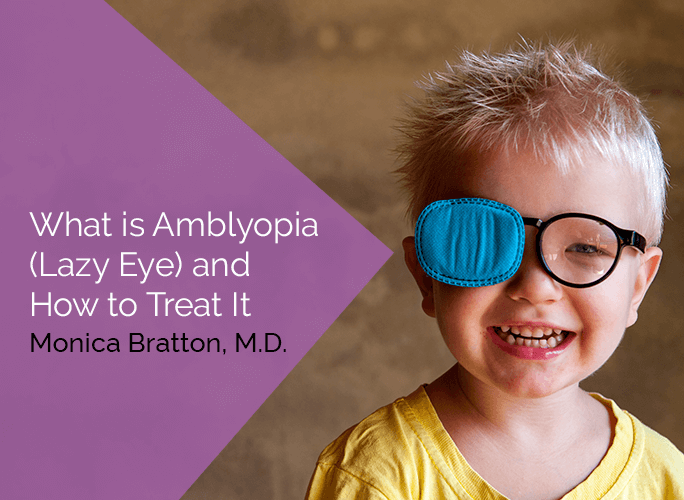
- Eye patches: Wearing a medical eye patch on the stronger eye as instructed by your pediatric ophthalmologist forces the amblyopic eye to work and strengthens its connection with the brain. Through occlusion therapy (patching), the brain will gradually begin to acknowledge and process the visual signals of the weaker eye. Improvement in vision will be gradual and may take weeks or months.
- Glasses: Eyeglasses can help correct refractive errors (nearsightedness, farsightedness, astigmatism). They may also be prescribed to blur vision in the stronger eye to maximize the use of the weaker eye. The prescription may change as the vision improves.
- Eye drops: Medicated eye drops work by temporarily blurring vision, forcing the brain to use the weaker eye.
Once amblyopia improves and the treatment period is complete, your child may still need to use the treatments periodically to prevent amblyopia from coming back.
Read Dr. Bratton’s Full Bio Here
More About Pediatric Specialist Monica Bratton, M.D.
Dr. Bratton is an ophthalmologist at the Marietta Eye Clinic who specializes in pediatric and adult strabismus. She serves the Kennestone, Acworth, Douglasville, West Cobb, and Towne Lake offices. Dr. Bratton graduated with her Bachelor of Arts from the University of Tennessee and received her medical degree from the University of Tennessee College of Medicine. She is a fellow of the American Academy of Ophthalmology and a member of the American Academy of Pediatric Ophthalmology and Strabismus and the Association for Research in Vision and Ophthalmology.
References and Additional Resources
https://www.nei.nih.gov/learn-about-eye-health/eye-conditions-and-diseases/amblyopia-lazy-eye
Amblyopia (Lazy Eye)
https://www.aao.org/eye-health/diseases/amblyopia-lazy-eye
Amblyopia: What Is Lazy Eye?
https://my.clevelandclinic.org/health/diseases/10707-amblyopia-lazy-eye
Amblyopia (Lazy Eye)
https://kidshealth.org/en/parents/amblyopia.html
Amblyopia (for Parents)
https://www.aao.org/disease-review/pediatric-cataracts-overview
Pediatric Cataracts: Overview
Set Up A Consultation
When it comes to your eyes, nothing beats a face-to-face consultation with one of our eye doctors. Request an appointment to meet with one of our specialists.