Pediatric Eye Care
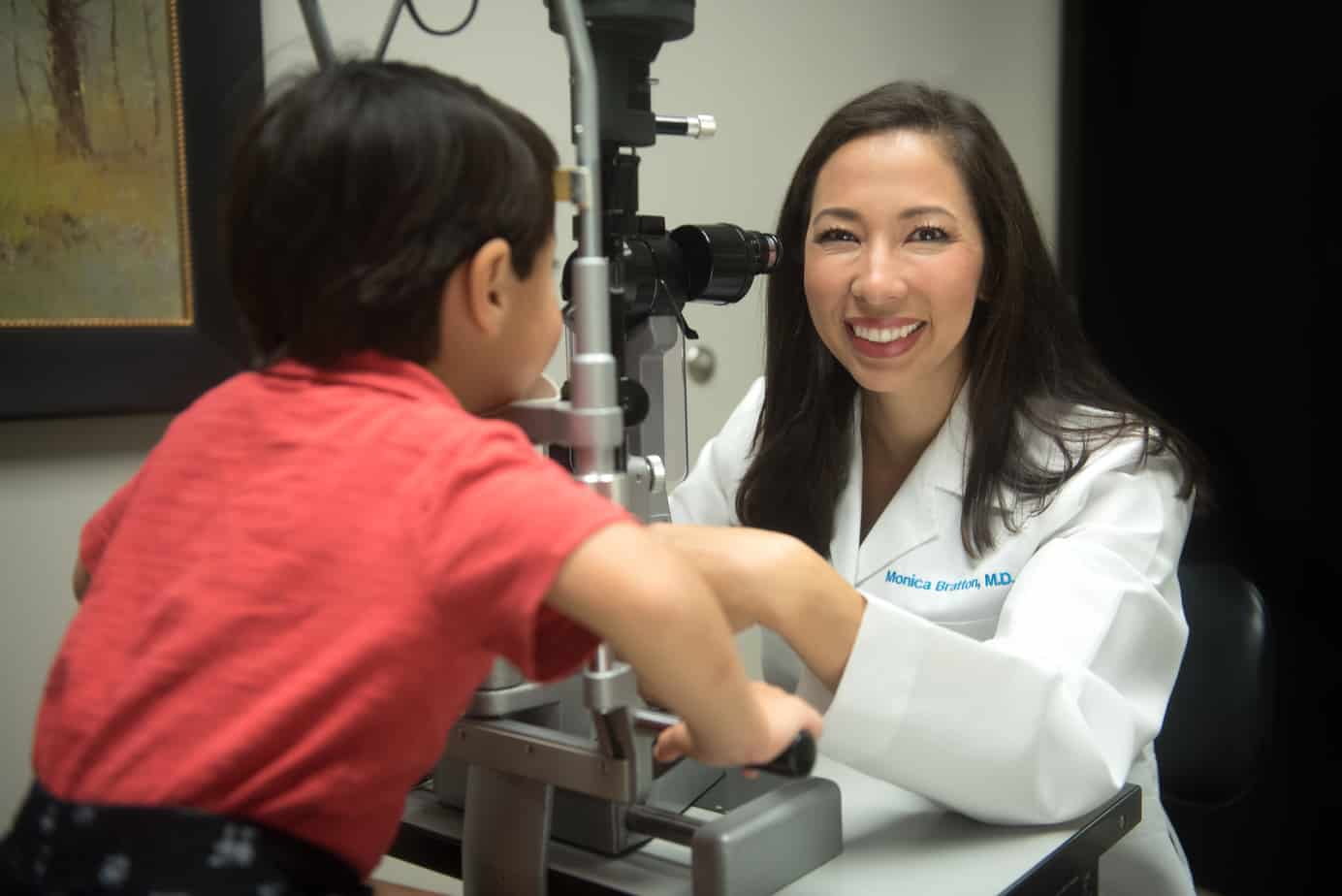
Monica Bratton, MD - Pediatric Specialist
Marietta Eye Clinic offers comprehensive pediatric eye care for families in and around Marietta, GA, and the North Atlanta suburbs. Our pediatric eye specialists focus on protecting and supporting your child’s vision as it develops. Vision screenings and eye health assessments begin in infancy and continue throughout childhood to help identify concerns as early as possible. When a screening indicates a potential issue—or when a child is at higher risk—a comprehensive eye examination may be recommended. Early detection and timely treatment of eye conditions can play an important role in supporting your child’s visual development, learning, and overall quality of life.
At our pediatric eye care offices, families can expect a fun, friendly atmosphere designed to put children at ease and help them feel comfortable during their visit. Our team is committed to making every interaction a positive, personalized experience tailored to each child’s needs. Above all, our goal is to help children develop a lifelong foundation for healthy vision.
Kid-focused eye care.
Each of our pediatric optometrists specializes in providing comprehensive eye care for babies and children. Each of our children’s eye doctors and pediatric eye surgeons diagnose and treat various childhood eye diseases and disorders, including lazy eye, refractive errors, like nearsightedness, farsightedness and astigmatism, excessive tearing, double vision, pediatric cataracts, pediatric glaucoma, and drooping eyelids as well as many other childhood eye problems.
We love to treat children from the time that they are six months old. This is because our kids eye doctor understands that a child’s eyesight develops very quickly in the first few months and years of life. Babies develop the ability to focus on near and far objects. Then, they start seeing things in 3D as their depth perception develops. They learn how to track objects, and their eyes develop the ability to focus together, known as convergence.
As they near school age, between the ages of 3 and 4, they’ll start to develop hand-eye coordination. They’ll develop visual memory, and they’ll start to be able to read the visual lines on an eye chart. Between the ages of 4 and 6, your child will learn how to recognize letters and objects, and they’ll start to learn how to read. When your child can see clearly, these tasks simply become milestones to pass, and your Marietta Eye Clinic kids optometrist wants to help give your children the best chance for success by ensuring that their eyes are healthy, and any vision problems are treated as soon as possible.
When should your child get their first eye exam?
The American Academy of Ophthalmology and the American Association for Pediatric Ophthalmology and Strabismus recommend timely, routine vision screening for infants and children to support healthy visual development and long-term learning. Because a child’s visual system is still developing, early detection of vision problems—particularly between ages 3 and 5—offers the best chance for effective treatment. Conditions such as amblyopia (lazy eye), strabismus (eye misalignment), and uncorrected refractive errors may not be obvious to parents but can lead to permanent vision loss if left untreated. Regular screening during infancy, preschool, and early school years helps identify these issues early, when treatment is most successful.
Effective vision screening should be quick, accurate, affordable, and paired with clear communication to families and appropriate follow-up care. Screenings may be performed in primary care offices, schools, or community programs by trained personnel, with referrals made when a child does not pass. Special attention is recommended for high-risk children, including those with a family history of serious eye disease or developmental concerns. While routine comprehensive eye exams are not necessary for all asymptomatic children, periodic screening throughout childhood plays a critical role in protecting vision, supporting academic success, and promoting overall health. For detailed age-specific recommendations and screening methods, the full joint policy statement is available for download here.
What should I bring to my child’s first eye exam?
In order to make your child’s first eye exam as stress-free as possible, it’s important to prepare beforehand. If your child is still in diapers, remember to bring a few and possibly a bottle if the appointment time coincides with a feeding time. If your child is a little older, you may want to bring a few toys or a stuffed animal and some snacks. If you know that your child’s eyes will be dilated during the appointment, remember to bring a pair of sunglasses.
Our children’s eye doctor will also need to know your child’s medical history and if there were any complications during your pregnancy and/or birth. Our pediatric eye doctor also needs to know about any early interventions, like eye surgery or known eye problems. If your child is on any medications or has any allergies, we’ll also need to know those things.
As a parent, what signs should I look for that my child needs an eye exam?
- Failed school and pediatrician vision screens
- Observation of child’s eye misalignment or movement disorder (crossing, walleye, wandering, drifting up or out, etc.)
- Slow eyesight development
- Child complaining of vision or pain
- Eye rubbing or redness/discharge
- Family history of childhood eye problems
- Adult misalignment or movement disorder (e.g., crossing, turned out, etc.)
- Double vision
Common Kids’ Eye Problems
Children can develop eye and vision problems as they grow and mature. Common kids’ eye problems include amblyopia or lazy eye, astigmatism, farsightedness, nearsightedness, excessive tearing, known as epiphora, cortical visual impairment, which is caused by problems with the visual center of the brain, double vision, and certain developmental abnormalities.
What are some childhood eye developmental abnormalities?
Developmental eye abnormalities generally start in the womb when the eyes fail to develop normally. Some childhood eye abnormalities include coloboma, which occurs due to changed or abnormal genes, microphthalmia or small eye, which occurs when one or both eyes are abnormally small, and cortical visual impairment, which occurs as a result of an abnormality with the vision center of the brain. Not all of these childhood eye problems have cures. However, glasses and other eye therapies can help the child cope with any vision loss.
What is strabismus, or crossed eyes, and how is it treated?
Strabismus is a misalignment of the eyes. It is estimated that 4% of the U.S. population has strabismus. Strabismus is most commonly described by the direction of the eye misalignment, including esotropia (turned inward), exotropia (turned outward), hypotropia (turned downward) and hypertropia (turned upward).
Strabismus treatment is designed to improve eye alignment so that the eyes can work better together. This is known as binocular vision. Treatment may involve eyeglasses, eye exercises, prism and/or eye muscle surgery. If your child has any problems that are often associated with strabismus, including amblyopia, ptosis, and cataracts, these are usually treated prior to any eye muscle surgery.
Read more here to learn more about Strabismus.
What is amblyopia, or lazy eye, and how is it treated?
Amblyopia is when vision in one or both eyes does not develop properly during childhood. It is sometimes called lazy eye. Amblyopia is a common problem in babies and young children, and it can lead to lifelong vision problems if it’s not treated early.
Amblyopia is usually corrected by encouraging the child to use their weaker eye. This is commonly accomplished by patching the strong eye. Other treatments may include using eye drops in the stronger eye to make the vision blurry or by wearing glasses with a lens that blurs vision in the stronger eye. By using these treatments, the child is forced to rely more on their weaker eye, which strengthens it.
What is double vision?
Double vision occurs when the eyes are misaligned. When double vision occurs, the eye sees the same object in two different places. The good news is that this can be treated with prism glasses, surgery for strabismus or Botox injections.
What are refractive errors?
The most common types of vision problems in children are caused by refractive errors. This occurs when the light that goes through the eye to the retina isn’t focused properly on the retina. This can be caused by an astigmatism, which occurs when the cornea isn’t properly shaped, and it can result in the child being nearsighted or farsighted. The good news is that glasses and contacts can correct refractive errors.
We offer a full spectrum of eye doctor services for children and adults at our 14 locations.
Set Up A Consultation
When it comes to your eyes, nothing beats a face-to-face consultation with one of our eye doctors. Request an appointment to meet with one of our specialists.
Related Pages, Education, and Specials
6/6/2018